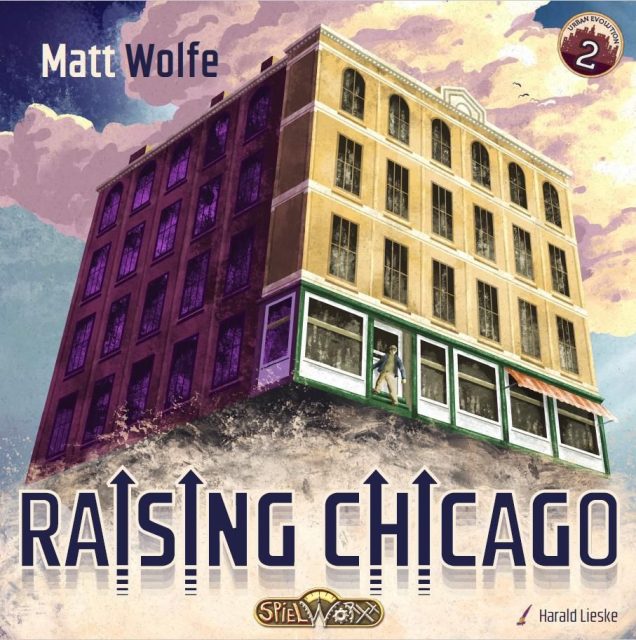
Raising Chicago
Raising Chicago at your next game night?
Add Raising Chicago to your collection, let your group vote on what to play, and keep track of winners and scores. Free, no credit card.
Add Raising Chicago to my collectionAlready have an account? Log in
- Designer Matt Wolfe
- Publisher Spielworxx , Capstone Games , Hobby Japan
- Illustration Harald Lieske
The description, FAQ and assessments for this game were generated with the help of artificial intelligence from the game data and reviewed editorially. Spotted a mistake? Let us know.
What to Expect
You represent one of four companies in 19th-century Chicago, gathering resources and competing to complete building projects. Each turn you place a tile on a resource slot for one of five projects and claim the covered resource. Projects are evaluated after placements; the winner pays resources, claims rewards, and places their tiles as building levels. The game mixes resource management with territorial tile placement and project-based scoring.
Who Is This Game For?
Aimed at hobby/advanced players, Raising Chicago requires planning and economic decision-making. With a 12+ age recommendation and ~120 minute playtime, it's suited for groups comfortable with longer, strategic games rather than casual quick plays.
How It Works
Core mechanics are Investment and Tile Placement: on your turn you place a tile on a project's resource slot and take that resource. After all players have placed, each project is resolved; the winning player spends resources to complete the project, gains the project reward, and places their tiles as levels under the building on the board. Scoring rewards clever placement, majority work in wards, and meeting council demands. Rounds repeat until final scoring decides the winner.
What Makes It Special
Designer Matt Wolfe frames a concrete historical problem—the raising of buildings to accommodate a sewer system—within City Building and Economic mechanics. The focus on project evaluation and resource competition distinguishes it from more open-ended city builders.
Pro
- Historical theme tied directly to gameplay
- Blend of Investment and Tile Placement offers strategic depth
- Project-based scoring provides clear round goals
- Designed for 2–4 players with longer sessions (~120 minutes)
Contra
- Long playtime may deter casual groups
- Requires learning for players unfamiliar with economic mechanics
Setting & atmosphere
Set in 19th-century Chicago during the construction of a citywide sewerage system, the game centers on lifting buildings to allow new street levels and hide the sewer network beneath them.
Tips for beginners
Focus first on understanding how projects are evaluated and the importance of majority control in wards before pursuing complex strategies.
Frequently asked questions
Can I play this solo?
No. The game is listed for 2–4 players; no solo mode is indicated in the provided data.
How long does a game really take?
Duration is given as about 120 minutes; include extra time for setup and rules explanation.
What prior experience do I need?
Age 12+ and experience with medium-weight economic/strategy games is recommended.
How does this compare to similar games?
Raising Chicago combines City Building with Investment and Tile Placement and emphasizes project resolution and resource competition.
Is this suitable for families?
With a 12+ age recommendation and higher complexity, it's better for families with older, experienced players.
What mechanic makes it special?
Tile Placement combined with Investment actions drives both resource acquisition and project competition.
Fazit
Raising Chicago is recommended for players who like historically themed economic strategy and can commit to ~120 minutes per game. Good choice if you enjoy structured, project-driven competition.
Raising Chicago at your next game night?
Add Raising Chicago to your collection, let your group vote on what to play, and keep track of winners and scores. Free, no credit card.
Add Raising Chicago to my collectionAlready have an account? Log in