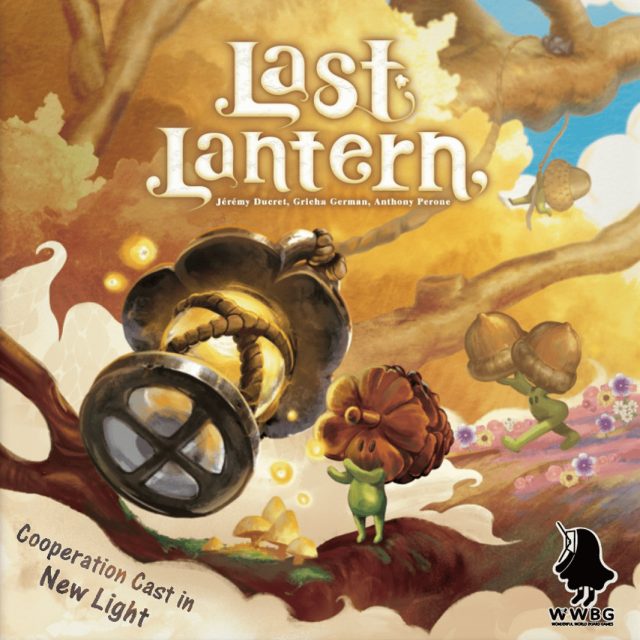
Last Lantern
Last Lantern at your next game night?
Add Last Lantern to your collection, let your group vote on what to play, and keep track of winners and scores. Free, no credit card.
Add Last Lantern to my collectionAlready have an account? Log in
- Designer Jérémy Ducret , Gricha German , Anthony Perone
- Publisher Wonderful World Board Games
- Illustration Zingco Kang , Yuan Momoco
The description, FAQ and assessments for this game were generated with the help of artificial intelligence from the game data and reviewed editorially. Spotted a mistake? Let us know.
What to Expect
In 2–4 players you silently choose sets of a tile and a token each round, place polyomino tiles on your path and collect tokens that grant powers. The game blends cooperative deduction with Tile Placement and Bag/Deck Building across short, simultaneous rounds. Observation and reading the shared board state are key to coordinated play.
Who Is This Game For?
Suited for families and hobby gamers who enjoy cooperative puzzles; the minimum age of 8 signals accessibility, while mechanics like Communication Limits and Bag/Deck Building reward deductive group play. At 30 minutes it fits short game sessions.
How It Works
Players simultaneously select one set (tile + token) without communicating, then place the tile on their path (Tile Placement) and gain tokens that activate abilities (Set Collection, Deck/Bag Building). Limited communication forces players to infer intentions from board state and tokens, creating a cooperative, deduction-driven flow.
What Makes It Special
Designed by Jérémy Ducret, Gricha German and Anthony Perone, Last Lantern pairs polyomino puzzling with silent, simultaneous choices. The mix of Tile Placement and Bag/Deck Building gives it a layered progression despite its short playtime.
Pro
- Short playtime (~30 minutes) good for quick sessions
- Blend of Tile Placement and Set Collection creates tactical depth
- Simultaneous silent choices encourage deductive teamwork
- Bag/Deck-Building adds a development layer over rounds
Contra
- Restricted communication can be tough for groups new to silent co-ops
- Players who prefer open discussion may find coordination frustrating
Setting & atmosphere
Players are canopy-dwellers advancing toward a dimming last lantern, using familiars and tiles to navigate a foggy path. The theme supports the puzzle-like progression without complex narrative rules.
Tips for beginners
Focus on visible board patterns and the tokens players collect; adapt choices based on observed tendencies rather than explicit signals.
Frequently asked questions
Can I play this solo?
No. The game is designed for 2–4 players (minimum players = 2).
How long does a game really take?
The listed duration is 30 minutes, making it a short, compact cooperative experience.
What prior experience do I need?
Basic experience with cooperative or puzzle games is helpful but not required; the game is accessible from age 8 upward.
How does this compare to similar games?
Last Lantern stands out by combining simultaneous silent choices with polyomino Tile Placement and Bag/Deck Building, emphasizing deductive coordination.
Is this suitable for families?
Yes. The minimum age of 8 and short playtime make it family-friendly, though the communication limit can be challenging for some children.
What mechanic makes it special?
The interplay of Communication Limits (silent simultaneous selection) with Tile Placement and Bag/Deck Building defines the core experience.
Fazit
A concise cooperative puzzle experience for 2–4 players that favors deduction and silent coordination. Recommended for groups who enjoy short, thoughtful co-ops.
Last Lantern at your next game night?
Add Last Lantern to your collection, let your group vote on what to play, and keep track of winners and scores. Free, no credit card.
Add Last Lantern to my collectionAlready have an account? Log in