If you regularly play several games in one evening, you'll eventually notice a pattern: the games at the start of the night are different from the ones at the end. This very topic came up in a board game discussion this week, and many groups describe the same thing. The evening has a shape, even when nobody plans it. If you plan it on purpose, hosting gets easier.
The opener: short and easy to join
Rarely is everyone on time. A good first game is short, quick to explain, and copes with someone joining after five minutes. Card games like No Thanks! (playnexi.com/en/games/no-thanks) or a dice game like Qwixx (playnexi.com/en/games/qwixx) work well because a game rarely takes more than 20 minutes. If six of you are already there, you can open with a communication game like Codenames, Spiel des Jahres 2016 (playnexi.com/en/games/codenames). The opener has a side benefit: you get a feel for the group's mood and can pick the main game to match.
The middle: the game everyone is looking forward to
Concentration peaks in the middle of the evening. This is the slot for the longer game, the new release from the convention, or the rematch after last time's draw. It helps if the main game is decided in advance. Then someone can read the rules beforehand, and you don't lose half an hour explaining at the table. When the group decides together what to play, everyone looks forward to it more: playnexi.com/en/spieleabstimmung
The closer: light and full of laughs
After the main game, energy often drops, but nobody wants to go home yet. Now is the time for games that don't need much thinking and get people talking. Just One, Spiel des Jahres 2019 (playnexi.com/en/games/just-one), or a quick bluffing game like Skull (playnexi.com/en/games/skull) are typical closers. The key is that you can stop at any time without someone having to leave in the middle of a game.
How many people fit at one table?
This came up this week too. Many describe it like this: with two or three, play is focused but can get quiet. Four to six gives the best mix of game and conversation. From seven people on, the table often splits into two groups whether you want it to or not. At that point it's worth planning two tables on purpose, with games of similar length so both finish around the same time. If you want to know the number in advance, you can cap the number of seats and keep a waitlist. Our article on big groups explains how: playnexi.com/en/blog/spieleabend-grosse-runde-warteliste
A night with an overall score
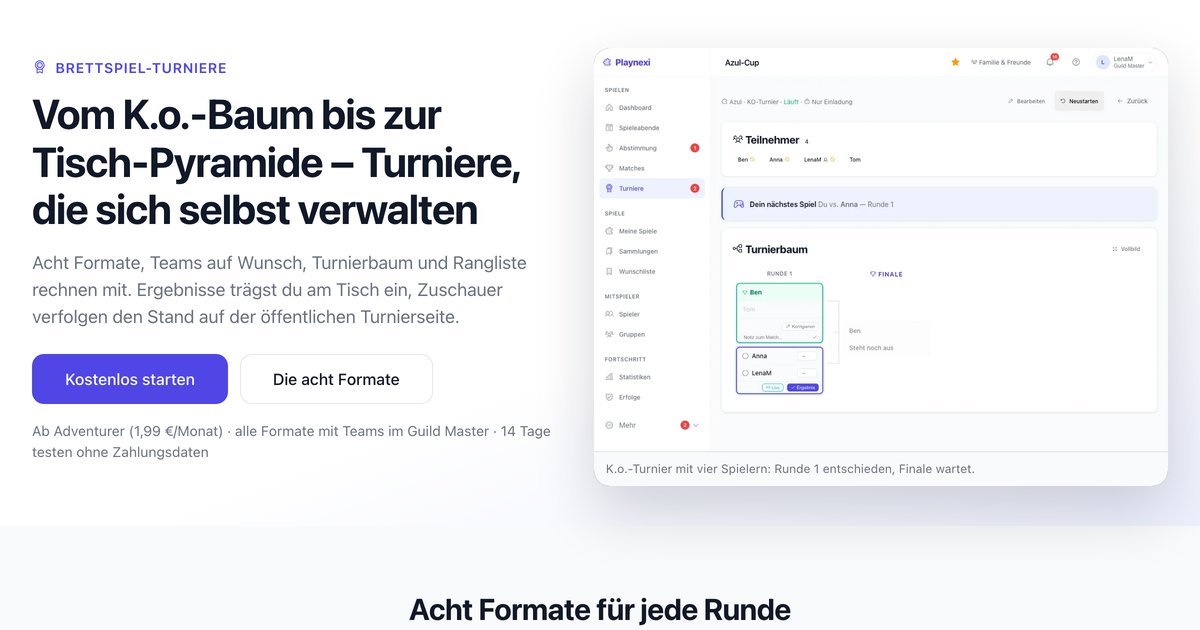
Some groups turn the evening into a small competition: every game awards points, and whoever leads overall at the end wins. This works when the games are of similar length and nobody has a big experience advantage. Scoring by placement rather than by in-game victory points works best. Otherwise a game with 150 points counts for more than one with ten. A small prize and a scoreboard everyone can see do the rest. For nights like this, Playnexi has tournament formats that keep the standings across several games: playnexi.com/en/brettspiel-turniere
Going without a plan works too
Not every evening has to be planned. But if you have an opener, a main game and a closer in mind, you'll have fewer decisions to make on the night and more time to play. More ideas for organizing are in our ten game night tips: playnexi.com/en/blog/spieleabend-organisieren-10-tipps
How about your group: do you have a regular opener, and what do you like to finish with?
This article was written with AI assistance and reviewed editorially.
Opener, main game, closer: giving your game night a shape
Probier Playnexi kostenlos aus
Manage your game collection, track results and plan game nights – all in one place.
Kostenlos registrieren