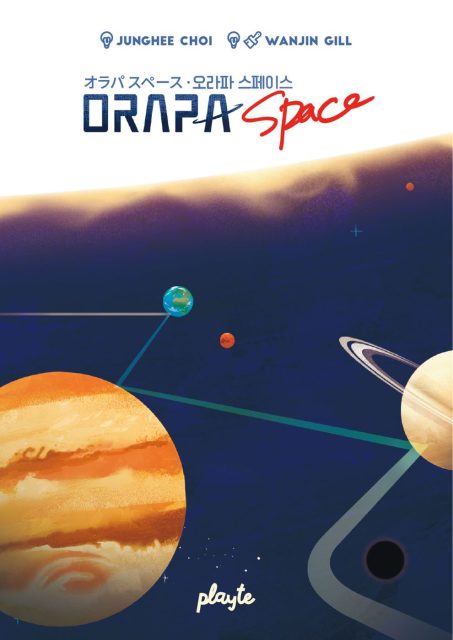
Orapa Space
Orapa Space at your next game night?
Add Orapa Space to your collection, let your group vote on what to play, and keep track of winners and scores. Free, no credit card.
Add Orapa Space to my collectionAlready have an account? Log in
- Designer Junghee Choi , Wanjin Gill
- Publisher Playte , Nice Game Publishing , Reflexshop
- Illustration Wanjin Gill
The description, FAQ and assessments for this game were generated with the help of artificial intelligence from the game data and reviewed editorially. Spotted a mistake? Let us know.
What to Expect
You face a compact deduction challenge: use laser beams and analyze reflected signals to uncover the positions, directions and 'colors' of planet-like pieces. The publisher describes a focused logic game that plays in about 20–25 minutes and is recommended for ages 8 and up. Rounds are short but demand careful observation and inference.
Who Is This Game For?
Orapa Space suits fans of Deduction and Puzzle games and families with older children (8+). Its ~25 minute playtime makes it ideal for short gaming sessions; the mechanic is logic-heavy but approachable without extensive rule knowledge.
How It Works
The core is Deduction: players send laser beams and interpret returned signals to deduce the hidden setup. According to the publisher, the game uses a small set of components (boards, planet sets, solution sheet) to deliver a compact puzzle experience for 2–5 players.
What Makes It Special
Designed by Junghee Choi and Wanjin Gill, Orapa Space uses laser reflection as its central deduction tool. The publisher notes it as a step up from Orapa Mine, suggesting a development on that concept. Fast playtime makes it a focused logic exercise rather than a long strategic affair.
Pro
- Short playtime (~25 minutes) – easy to replay
- Clear deduction/puzzle focus
- Flexible player count (2–5)
- Lean components make setup quick (publisher description)
Contra
- Limited material depth – emphasis on single-round puzzles
- Not aimed at players seeking long strategic campaigns
Setting & atmosphere
A light sci-fi premise: players discover positions and properties of planet-like pieces via lasers. The theme supports the puzzle mechanics rather than being simulation-heavy, per the publisher text.
Tips for beginners
Start with basic laser tests, observe returned signals carefully, and eliminate possibilities step by step.
Frequently asked questions
Can I play this solo?
No. The listed player count is 2–5; no solo mode is indicated in the provided data.
How long does a game really take?
Duration is given as about 25 minutes; the publisher text also mentions around 20 minutes per game.
What prior experience do I need?
Some familiarity with deduction or puzzle games is helpful since play relies on logical inference.
How does this compare to similar games?
Orapa Space emphasizes laser-based deduction and is described by the publisher as a step up from Orapa Mine.
Is this suitable for families?
Yes. It is listed for ages 8+, making it family-friendly for older children.
What mechanic makes it special?
Deduction through analysis of laser reflections is the standout mechanic.
Fazit
A solid, quick deduction puzzle for families and logic-game fans. Recommended if you want tight, thought-focused rounds; less so if you prefer long, strategic multiplayer sessions.
Orapa Space at your next game night?
Add Orapa Space to your collection, let your group vote on what to play, and keep track of winners and scores. Free, no credit card.
Add Orapa Space to my collectionAlready have an account? Log in