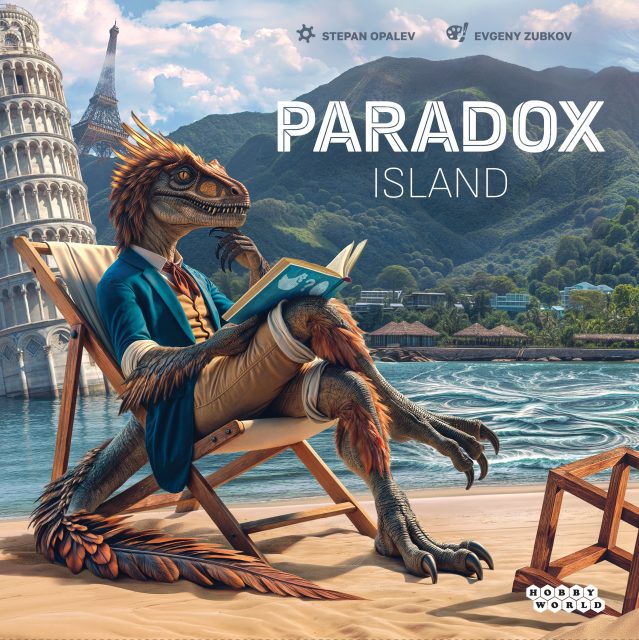
Paradox Island
Paradox Island at your next game night?
Add Paradox Island to your collection, let your group vote on what to play, and keep track of winners and scores. Free, no credit card.
Add Paradox Island to my collectionAlready have an account? Log in
- Designer Stepan Opalev
- Publisher Hobby World , asmodee
- Illustration Evgeny Zubkov
The description, FAQ and assessments for this game were generated with the help of artificial intelligence from the game data and reviewed editorially. Spotted a mistake? Let us know.
What to Expect
One player is the Omnipotence Paradox (OP) who sees the whole island; the other players are captives exploring blindly on a modular hex grid. Captives announce movements while reconstructing the map on their sheets and try to complete missions. Spaces on the island have positive or negative effects, and the OP controls three tokens (Rock, Bush, Wave) to influence captives' plans.
Who Is This Game For?
Suitable for players who enjoy asymmetrical deduction and exploration. With a 90-minute playtime and emphasis on note-taking and reconstruction, it fits better among hobby/enthusiast games than light family fare. Familiarity with Hidden Movement mechanics helps.
How It Works
One player (OP) knows the island layout; captives move across a hexagon grid with up to two actions per turn (move, safe move, restore energy). After a captive announces movement, the OP names the destination aloud—other players hear movements and mark them on their map to deduce layout. The game uses Area Movement, Hidden Movement, Deduction, Modular Board and Variable Set-up to create asymmetric, information-driven play.
What Makes It Special
Design by Stepan Opalev. Paradox Island combines Hidden Movement and Deduction with a modular hex-board and variable setup, creating a distinct One‑versus‑Many dynamic where only the OP has full information. Variable Player Powers and Events add tactical variety.
Pro
- Clear asymmetry: one informed OP vs. multiple uninformed captives
- Strong deduction and note-taking gameplay driven by Hidden Movement
- Modular board and variable setup boost replayability
- Events and variable powers add strategic variety
Contra
- Around 90 minutes per game requires time commitment
- Higher cognitive load due to deduction and mapping
- No solo mode indicated in the provided data
Setting & atmosphere
Players explore a mysterious island represented by hex spaces with varied effects. The OP manipulates the island using three pieces (Rock, Bush, Wave) mentioned in the game description.
Tips for beginners
Focus on recording announced movements accurately and learn the typical effects of spaces before attempting complex plans.
Frequently asked questions
Can I play this solo?
No. The game supports 2–4 players; a solo mode is not indicated in the data.
How long does a game really take?
The listed duration is about 90 minutes; first plays with setup and explanation may run longer.
What prior experience do I need?
Experience with Hidden Movement or deduction games is helpful because note-taking and inference are core to play.
How does this compare to similar games?
Paradox Island emphasizes a modular hex map and a One‑versus‑Many structure where only one player sees the full map, combining exploration with deduction.
Is this suitable for families?
Minimum age is 10, but the deduction complexity and playtime make it more suitable for hobby groups than casual family play.
What mechanic makes it special?
The blend of Hidden Movement, Deduction and Modular Board is the defining mechanical combination.
Fazit
A good pick for groups that like asymmetrical deduction and map reconstruction; best with players comfortable with note-taking. Not aimed at those seeking short, casual family games.
Paradox Island at your next game night?
Add Paradox Island to your collection, let your group vote on what to play, and keep track of winners and scores. Free, no credit card.
Add Paradox Island to my collectionAlready have an account? Log in