Kano
Kano at your next game night?
Add Kano to your collection, let your group vote on what to play, and keep track of winners and scores. Free, no credit card.
Add Kano to my collectionAlready have an account? Log in
- Designer Pablo Jiménez , Angel Pintero
- Publisher Matagot
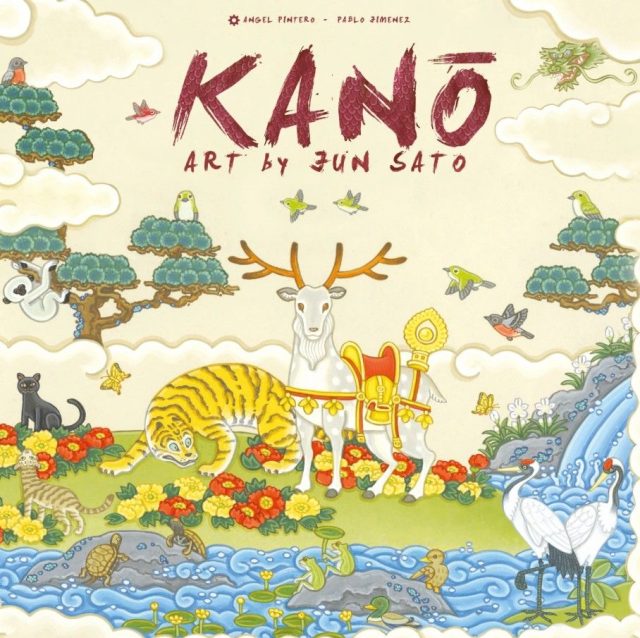
- Illustration Jun Sato
The description, FAQ and assessments for this game were generated with the help of artificial intelligence from the game data and reviewed editorially. Spotted a mistake? Let us know.
What to Expect
Players create Emakimono handscrolls by taking paint pots from a shared central palette and placing them on their personal board. Kano mixes Tile Placement, Pattern Building and Set Collection: paints fall to the lowest available space, adjacent same-color pots can be collected together, and completed patterns are replaced by Artwork tiles for scoring. The game ends when a player fills their board and final scoring occurs.
Who Is This Game For?
Aimed at hobby gamers and experienced families, Kano demands spatial planning and tactical forethought. With a recommended age of 12+ and a playtime of about 40 minutes, it suits groups that enjoy puzzle-like placement games without marathon sessions.
How It Works
A central mat holds colorful paint pots that players can swap to set up moves; swapping adjacent pots is a key tactical action. In your turn you must take at least one pot; you may take multiple if they are the same color and adjacent in a row or column (Set Collection). When placing on your board, gravity makes pots fall to the lowest free space (Tile Placement, Pattern Building). Completed patterns convert to Artwork tiles that score, and secret Masterpiece cards and shifting goal sheets add strategic variety.
What Makes It Special
Designed by Pablo Jiménez and Angel Pintero, Kano pairs shared spatial puzzle play with personal board optimization using Tile Placement and Pattern Building. The Japanese art theme (Emakimono) and the central palette as a contested resource distinguish it from pure engine or hand-management games.
Pro
- Short playtime (~40 minutes) for quick sessions
- Blend of Tile Placement, Pattern Building and Set Collection
- Shared central mat creates player interaction over resources
- Accessible rules with tactical depth from the gravity mechanic
Contra
- Spatial planning demands may deter casual players
- Limited to 2–4 players, not for large groups
- Secret objectives and shifting goals add complexity
Setting & atmosphere
Players compose traditional Japanese Emakimono handscrolls; the game’s theme centers on art and Japanese aesthetics as described by the publisher.
Tips for beginners
Focus on building stable, small patterns first and watch the central palette to anticipate available colors.
Frequently asked questions
Can I play this solo?
No. Kano is listed for 2–4 players (no solo mode indicated).
How long does a game really take?
The listed duration is about 40 minutes; include extra time for explanation and setup.
What prior experience do I need?
Players familiar with tile-placement or set-collection mechanics will adapt quickly; recommended age is 12+.
How does this compare to similar games?
Kano emphasizes a shared central palette and gravity-based placement, creating a stronger spatial-puzzle feel than many pure set-collection titles.
Is this suitable for families?
Yes for families with older kids (12+); younger children may struggle with the spatial planning required.
What mechanic makes it special?
The interplay of Tile Placement, Pattern Building and Set Collection around a shared central mat is the standout mechanic.
Fazit
Kano is a concise, tactical tile-placement game for 2–4 players that rewards spatial planning. Recommended for players who like pattern-building in a sub-hour playtime.
Kano at your next game night?
Add Kano to your collection, let your group vote on what to play, and keep track of winners and scores. Free, no credit card.
Add Kano to my collectionAlready have an account? Log in