A game night with kids runs on different rules than one with adults. Attention spans are shorter, losing hurts more, and an eight-year-old does not want to spend ten minutes watching grown-ups look up rules. At the same time, kids are often the most eager players at the table when the game fits.
Start short, stop early
Length matters most. For kids up to about eight, 15 to 30 minutes per game is a good range. Two short games beat one long game that falls apart halfway. Stop while everyone still wants more. A fixed end time, say 7:30, saves you the bargaining.
You can shape the evening the same way as with adults: a quick game to warm up, then the main game, and something silly to finish. Our article on warm-up, main game and closer shows what that arc looks like (playnexi.com/en/blog/spieleabend-ablauf-aufwaermen-hauptspiel-absacker).
Together instead of against each other
Cooperative games take the sting out of losing. Everyone wins or loses together, and adults can help without it looking like they're going easy on the kids. One tip: let the child have the final say on their own turn. Otherwise the loudest adult ends up playing alone while the child just moves pieces.
In competitive games, luck helps. A die or a shuffled deck gives kids a real chance against adults, without anyone having to play badly on purpose.
Award lists as a shortcut
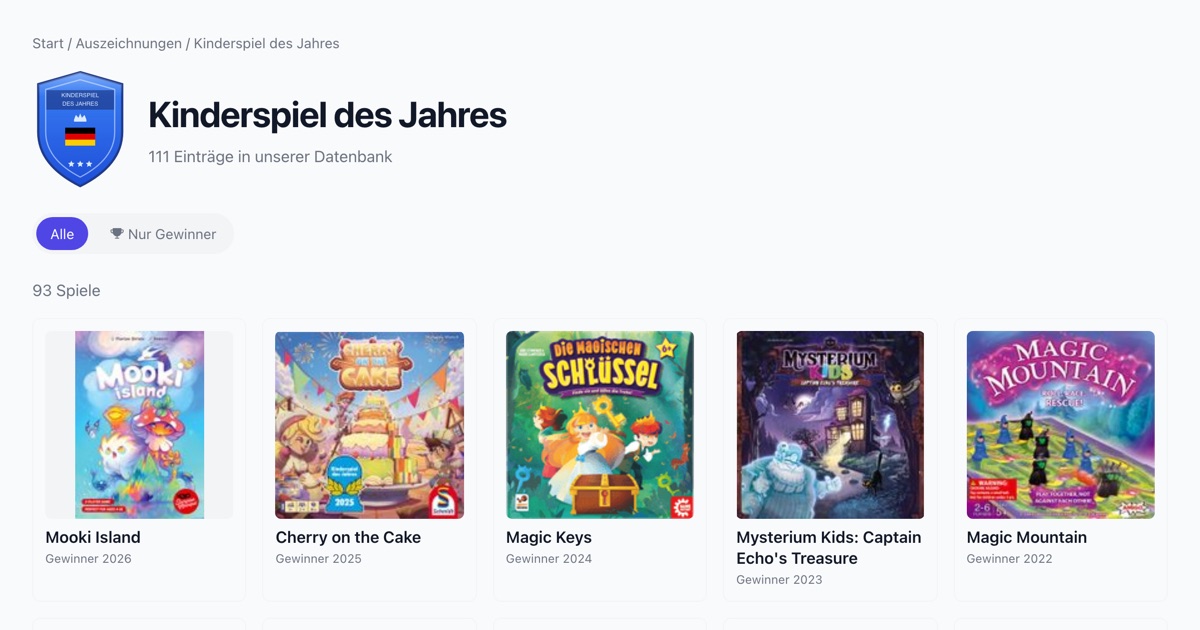
If you don't know where to start, the Kinderspiel des Jahres (Children's Game of the Year) is a good guide. Since 2001 its jury has honoured games for children up to about eight that parents and older siblings should enjoy too. All winners are on our Kinderspiel des Jahres page (playnexi.com/en/awards/kinderspiel-des-jahres).
For the youngest, age four and up
Mooki Island won the Kinderspiel des Jahres 2026 (playnexi.com/en/games/mooki-island). It is a duel for two: you take turns picking one of two open cards, and whoever has the most cards of a Mookie family gets its trophy. A game takes about 15 minutes. Speedy Roll, the 2020 winner (playnexi.com/en/games/hedgehog-roll), is more about dexterity than thinking: a hedgehog ball with Velcro spikes rolls across the table and picks up apples, leaves and mushrooms. There is a race and a variant where everyone plays together against the fox.
Ages five and six
In Magic Mountain (playnexi.com/en/games/magic-mountain), marbles roll down a sloped track, and everyone works together to get their apprentice wizards down to the valley before the witch marbles knock them over. Dragomino (playnexi.com/en/games/dragomino) is the kids' version of Kingdomino: place tiles, match landscapes, collect dragon eggs.
Mysterium Kids: Captain Echo's Treasure (playnexi.com/en/games/mysterium-kids-captain-echo-s-treasure) is cooperative and plays up to six. One child is the ghost and makes sounds with a tambourine, the others guess which object is meant. Magic Keys (playnexi.com/en/games/magic-keys) and Cherry on the Cake (playnexi.com/en/games/cherry-on-the-cake) won in 2024 and 2025 respectively. The first is about pushing your luck and stopping in time; in the second, you stack cake layers by eye.
Eight and up: the bridge to grown-up games
From about eight, many family games that adults enjoy start to work. The German Children's Game Prize 2026 (Deutscher Kinderspielepreis) went to Toriki (playnexi.com/en/games/toriki-the-castaway-island), a cooperative story adventure with an app. Stranded kids explore an island, and a session takes about 20 minutes. You can save at any time, and you cannot lose.
Kingdomino (playnexi.com/en/games/kingdomino) was Spiel des Jahres 2017 and is the natural next step after Dragomino. Just One (playnexi.com/en/games/just-one) is a cooperative word game for three to seven players where grandparents and kids guess together.
Let the kids choose
Kids would rather play what they picked themselves. Put two or three games on the table and let them choose instead of deciding for them. With several kids, take turns choosing. How a bigger group can vote fairly is covered in a separate article (playnexi.com/en/blog/fair-abstimmen-was-gespielt-wird).
Teach the rules without lecturing
Read the rules on your own beforehand, explain only what's needed and play the first round as a practice round with everything face up. Bring in special rules only when they come up. And if a rule is too much for the youngest, leave it out at first.
Practising winning and losing
Losing is part of it, and the game table is a good place to practise. After a game, say briefly what went well instead of only celebrating the winner. If you play regularly, keep a ranking across several evenings, with points for placement rather than in-game score. That way a child who loses badly once still has a real chance in the overall ranking. A tally on the fridge is enough. If you like, you can also log matches in Playnexi.
A fixed date
Family game nights stick best when they have a fixed slot in the calendar, say every other Friday. When grandparents or friends join, an invitation people can RSVP to helps. More on that in our ten tips for organising a game night (playnexi.com/en/blog/spieleabend-organisieren-10-tipps).
In the end, the evening was a success if the kids ask when you'll play again. Who won hardly matters.
This article was written with AI assistance and reviewed editorially.
Game night with kids: what makes family game nights work, and award winners to start with
Probier Playnexi kostenlos aus
Manage your game collection, track results and plan game nights – all in one place.
Kostenlos registrieren