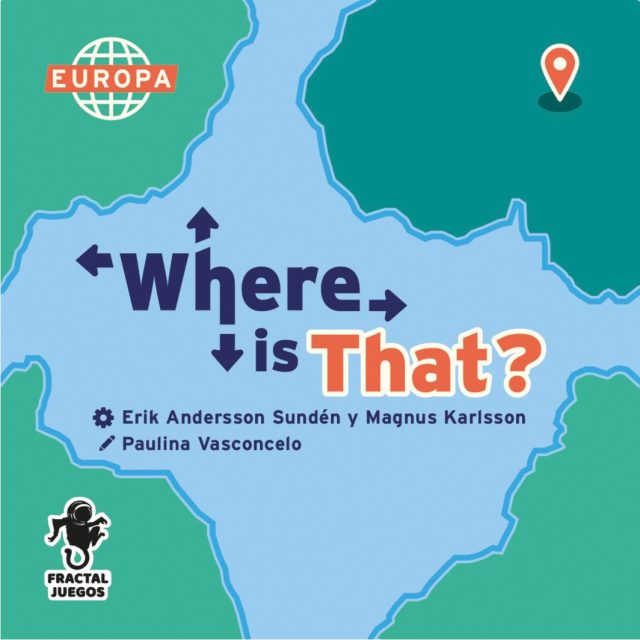
Where is That?: Europe
Where is That?: Europe at your next game night?
Add Where is That?: Europe to your collection, let your group vote on what to play, and keep track of winners and scores. Free, no credit card.
Add Where is That?: Europe to my collectionAlready have an account? Log in
- Designer Magnus Karlsson , Erik Andersson Sundén
- Publisher Fractal Juegos , Gémklub , SNAK
- Illustration Christian Engemand Blom , Paulina Vasconcelo
The description, FAQ and assessments for this game were generated with the help of artificial intelligence from the game data and reviewed editorially. Spotted a mistake? Let us know.
What to Expect
You will place tiles/cards to build maps and test geographic knowledge in two modes. 'Cartographer’s Corner' has players build a personal map in front of them, while 'Continental Shake Up' creates a shared map on the table where only correctly placed pieces remain. Riskier placements award more points, creating tension between safe and high-reward moves.
Who Is This Game For?
Aimed at families and casual players aged 8+, the ~25 minute play time makes it suitable for quick game nights or party sessions. The simple Tile Placement mechanic requires little prior experience and appeals to players who enjoy trivia and light puzzles.
How It Works
Core mechanic is Tile Placement: players place cards/tiles to complete a map. In Cartographer’s Corner you develop a personal map over rounds; in Continental Shake Up the group builds a central map and incorrect placements are removed. Higher-risk placements yield higher points, forcing decisions between cautious and ambitious plays.
What Makes It Special
Designed by Magnus Karlsson and Erik Andersson Sundén, the game focuses on European geography and geocaching-style play. It's part of the 'Where is That' series and is categorized as a party/puzzle/trivia title. Its short duration makes it easy to slot into casual gaming sessions.
Pro
- Two distinct modes: personal and shared map building
- Short playtime (~25 minutes) for quick sessions
- Easy-to-learn Tile Placement mechanic
- Family- and party-friendly for ages 8+
Contra
- Limited to 2–4 players, not for large groups
- Limited depth for heavier gamers
- Appeal depends on interest in geography/trivia
Setting & atmosphere
Theme centers on Europe and geocaching/geography: tiles are placed to form regions and a map. The presentation is puzzle-like and driven by geographic placement as described by the publisher.
Tips for beginners
Start with conservative placements to avoid losing pieces; try both modes to find your preferred approach.
Frequently asked questions
Can I play this solo?
No. The game is listed for 2–4 players, so a solo mode is not indicated.
How long does a game really take?
Duration is about 25 minutes; including setup and explanation a session may run slightly longer.
What prior experience do I need?
Little to none. The Tile Placement mechanic is straightforward and mainly rewards geographic knowledge.
How does this compare to similar games?
It mixes geography trivia with tile placement and offers both personal and shared map modes, differing from pure quiz or pure puzzle titles.
Is this suitable for families?
Yes. Minimum age is 8 and the quick, simple rules make it family-friendly.
What mechanic makes it special?
Tile Placement is the defining mechanic, used to build geographic maps.
Fazit
Good pick if you want a quick, knowledge-based tile-laying game about Europe. Less suitable for players seeking deep, long strategic experiences.
Where is That?: Europe at your next game night?
Add Where is That?: Europe to your collection, let your group vote on what to play, and keep track of winners and scores. Free, no credit card.
Add Where is That?: Europe to my collectionAlready have an account? Log in