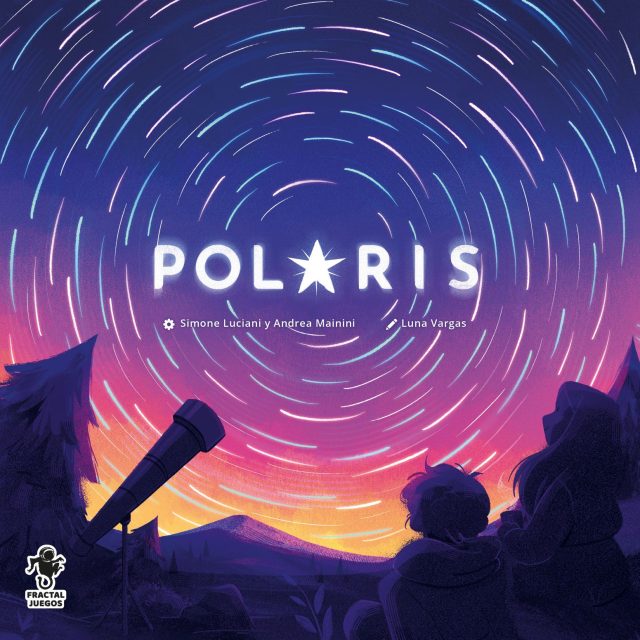
Polaris
Polaris at your next game night?
Add Polaris to your collection, let your group vote on what to play, and keep track of winners and scores. Free, no credit card.
Add Polaris to my collectionAlready have an account? Log in
- Designer Simone Luciani , Andrea Mainini
- Publisher Fractal Juegos , Detestable Games , Evrikus , Maldito Games , Wonderbow Games
- Illustration Luna Vargas
The description, FAQ and assessments for this game were generated with the help of artificial intelligence from the game data and reviewed editorially. Spotted a mistake? Let us know.
What to Expect
You place stars on a shared sky to form constellations and meet objectives across five scoring phases that get progressively shorter. Moon phases limit where you can place stars; each turn you choose one of three actions: draw cards, play cards, or take shooting stars. Victory is determined by most points after the final scoring.
Who Is This Game For?
Polaris suits hobby and family players with some experience: minimum age 8 and about 50 minutes playtime (game-night length). Players who enjoy spatial pattern building and tactical area control will appreciate it; complete newcomers may need a short learning period.
How It Works
Gameplay centers on placing star tokens guided by cards and changing moon phases. Mechanics listed include Hand Management, Pattern Building, Connections and Area Majority / Influence: cards enable placements or effects, building patterns and connecting stars score points, and area majorities matter during scoring. The shortening scoring phases force adaptive planning.
What Makes It Special
Designed by Simone Luciani and Andrea Mainini, Polaris ties an astronomy theme to abstract mechanics like Pattern Building and Area Majority. The use of five variably sized scoring phases and moon-phase placement constraints distinguishes it from many classic abstract titles.
Pro
- Cohesive astronomy-themed abstract concept (constellations)
- Combination of Hand Management, Pattern Building and Area Majority adds depth
- Approximately 50 minutes fits a typical game night
- Designed by Simone Luciani & Andrea Mainini
Contra
- Combined mechanics can be unfamiliar to absolute beginners
- No solo option (designed for 2–4 players) — not suited for solo play
Setting & atmosphere
The game is set in the night sky: players place stars and form constellations, influenced by moon phases. The astronomy motif frames the abstract gameplay without heavy simulation.
Tips for beginners
Focus first on simple patterns and securing majorities in local areas; use early rounds to learn moon-phase placement constraints and card effects.
Frequently asked questions
Can I play this solo?
No. Polaris is specified for 2–4 players; no solo mode is listed in the provided data.
How long does a game really take?
The listed duration is about 50 minutes; include setup and explanation time in your session planning.
What prior experience do I need?
Some experience with hobby-level games helps, since Hand Management and Pattern Building are central.
How does this compare to similar games?
Polaris combines Pattern Building with Area Majority and uses phase-based placement constraints (moon phases), which creates shifting tactical decisions.
Is this suitable for families?
With a minimum age of 8 and ~50 minute playtime, it fits families who play hobby games; very young or inexperienced children may struggle.
What mechanic makes it special?
The interplay of Pattern Building and Area Majority / Influence alongside Hand Management is the defining mechanical core.
Fazit
Polaris is a tactical abstract for 2–4 players that blends pattern-building and majority competition. Recommended for players who enjoy 50-minute, position-focused strategy games.
Polaris at your next game night?
Add Polaris to your collection, let your group vote on what to play, and keep track of winners and scores. Free, no credit card.
Add Polaris to my collectionAlready have an account? Log in