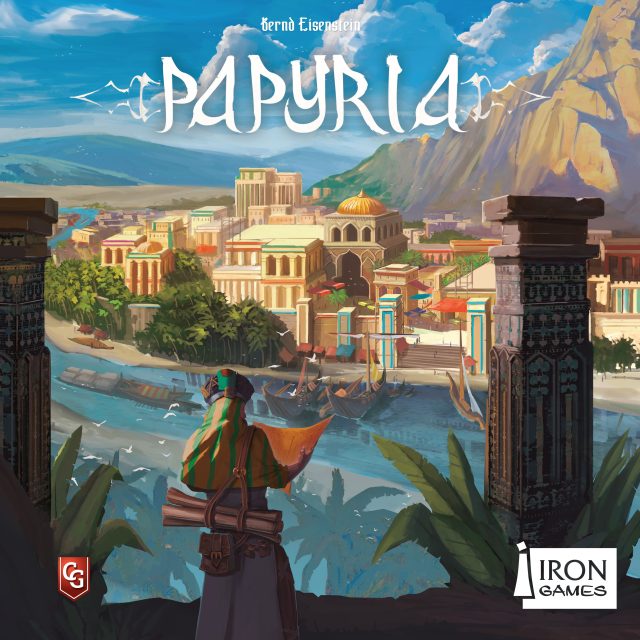
Papyria
Papyria at your next game night?
Add Papyria to your collection, let your group vote on what to play, and keep track of winners and scores. Free, no credit card.
Add Papyria to my collectionAlready have an account? Log in
- Designer Bernd Eisenstein
- Publisher Irongames , Capstone Games , Fentasy Games
- Illustration Daniel Cunha , Klemens Franz
The description, FAQ and assessments for this game were generated with the help of artificial intelligence from the game data and reviewed editorially. Spotted a mistake? Let us know.
What to Expect
You move a wanderer or ship around a rondel to create canal networks, discover inventions, develop mines and build temples and cities. On your destination space you choose two of three actions: take a tile, build (city/temple/mine) or produce resources like lapis and papyrus. The game ends when certain goods are depleted and end-game tiles are revealed and fulfilled, followed by several final scorings.
Who Is This Game For?
Papyria suits experienced hobby gamers and fans of civilization-style games aged 14 and up. With an approximate duration of 120 minutes it's an evening-length, strategy-focused game. A solo mode is included, and the title supports 1–4 players.
How It Works
Players use a rondel to move their wanderer or ship and use Action Drafting to pick two of three possible actions on the target space. Worker Placement and Tile Placement are used for building cities, temples and mines, while Movement Points and production generate lapis and papyrus. Variable Set-up changes starting conditions and End Game Bonuses influence final scoring.
What Makes It Special
Designed by Bernd Eisenstein, Papyria blends rondel movement with Worker-Placement and Tile-Placement mechanics. The mix of Action Drafting and Variable Set-up gives variety across plays. As an Ancient/Civilization title it ties theme and mechanics closely to Mesopotamian development.
Pro
- Combines Rondel, Worker-Placement and Tile-Placement for diverse decisions
- Variable Set-up increases replayability
- Includes solo rules (1–4 players)
- Strong thematic integration with ancient Mesopotamia
Contra
- Around 120 minutes per game makes sessions lengthy
- Multiple intertwined mechanics raise the entry barrier for newcomers
Setting & atmosphere
Set in Mesopotamia around 1500 BC, the game focuses on canals, city-building, mining lapis and producing papyrus, as described by the designer.
Tips for beginners
Learn the rondel movement and the three action types first; plan resource production to enable future builds.
Frequently asked questions
Can I play this solo?
Yes. The game includes solo rules and supports 1–4 players.
How long does a game really take?
Expect about 120 minutes per session; setup and rule explanations add time for first plays.
What prior experience do I need?
Familiarity with multi-step strategies and mechanics like Rondel and Worker-Placement is helpful.
How does this compare to similar games?
Papyria stands out by combining Action Drafting and rondel movement with Worker-Placement and Tile-Placement rather than focusing on a single core mechanic.
Is this suitable for families?
With a minimum age of 14 and notable complexity, it's better suited to families with older, experienced players.
What mechanic makes it special?
The interplay of Rondel (movement), Action Drafting and Worker-Placement defines its decision space.
Fazit
Papyria is a solid choice for players seeking layered strategic choices in a civilization setting. Its complexity and length make it less suitable for casual groups.
Papyria at your next game night?
Add Papyria to your collection, let your group vote on what to play, and keep track of winners and scores. Free, no credit card.
Add Papyria to my collectionAlready have an account? Log in