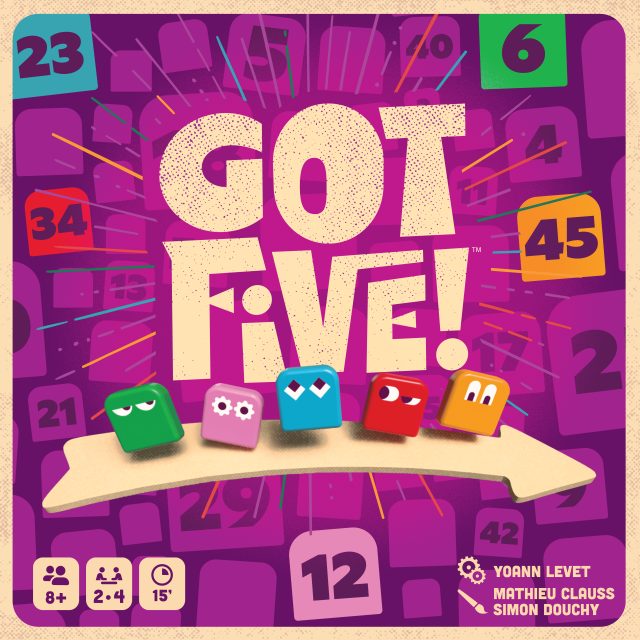
Got Five!
Got Five! at your next game night?
Add Got Five! to your collection, let your group vote on what to play, and keep track of winners and scores. Free, no credit card.
Add Got Five! to my collectionAlready have an account? Log in
- Designer Yoann Levet
- Publisher Blue Orange (EU) , asmodee , Blue Orange Games , Brain Games , EPEE
- Illustration Mathieu Clauss , Simon Douchy
The description, FAQ and assessments for this game were generated with the help of artificial intelligence from the game data and reviewed editorially. Spotted a mistake? Let us know.
What to Expect
Each player has five hidden numbers visible to opponents. Players reveal shared tiles, ask neighbors for categorized or comparative clues, and use notes to eliminate possibilities. You can declare “Got Five!” and immediately win if your ascending five-number guess is correct; a wrong declaration eliminates you. Rounds are tense and fast, centered on public information and sharp logic.
Who Is This Game For?
Got Five! suits players who enjoy deduction and brief, focused rounds. With a playtime of about 15 minutes it's good for game nights as a quick mental duel. The rules are simple, but familiarity with deduction games helps to work efficiently with clues and notes.
How It Works
Gameplay is built around Deduction and Paper‑and‑Pencil note taking. On your turn you reveal a new tile to the public supply and use a face‑up tile to ask a neighbor for a clue — either placing it relative to your hidden numbers or comparing dot counts. Publicly revealed tiles accumulate information, and players may announce a solution at any time. Incorrect announcements cause Player Elimination; the game can end suddenly when someone is correct (Sudden Death Ending).
What Makes It Special
Designed by Yoann Levet, Got Five! emphasizes fully public clues and neighbor questioning as its core loop. The mix of deduction, note taking and an immediate win condition creates a race dynamic. The title is listed under Misc: Mensa Select in its family metadata.
Pro
- Short playtime (~15 minutes) for multiple rounds
- Public information drives the deduction process
- Rules are straightforward and quick to teach
- High player interaction through targeted questions
Contra
- Player elimination on wrong guesses can be harsh
- Requires focused note‑taking; not a light party choice
Setting & atmosphere
The game is abstract and number‑centric: each player reconstructs a personal ascending five‑number sequence using visible tiles and clues. There is no narrative setting; the focus is pure deduction.
Tips for beginners
Take systematic notes and avoid premature guesses; gather multiple independent clues before declaring a solution.
Frequently asked questions
Can I play this solo?
No. Got Five! is designed for 2–4 players (players.min = 2).
How long does a game really take?
Playtime is about 15 minutes; with explanation it remains a short game.
What prior experience do I need?
Basic experience with deduction games helps, though the rules themselves are easy to learn.
How does this compare to similar games?
Got Five! focuses on public, shared tiles and neighbor questioning combined with an immediate win condition, unlike games with mostly hidden info.
Is this suitable for families?
With minimum age 8 it can suit families, but the deduction and note‑taking demand concentration.
What mechanic makes it special?
Deduction combined with Paper‑and‑Pencil and Player Elimination/Sudden Death Ending defines the gameplay.
Fazit
A compact, deduction‑focused race for 2–4 players that rewards careful elimination and timing. Best for groups who enjoy logical puzzles in short sessions.
Got Five! at your next game night?
Add Got Five! to your collection, let your group vote on what to play, and keep track of winners and scores. Free, no credit card.
Add Got Five! to my collectionAlready have an account? Log in