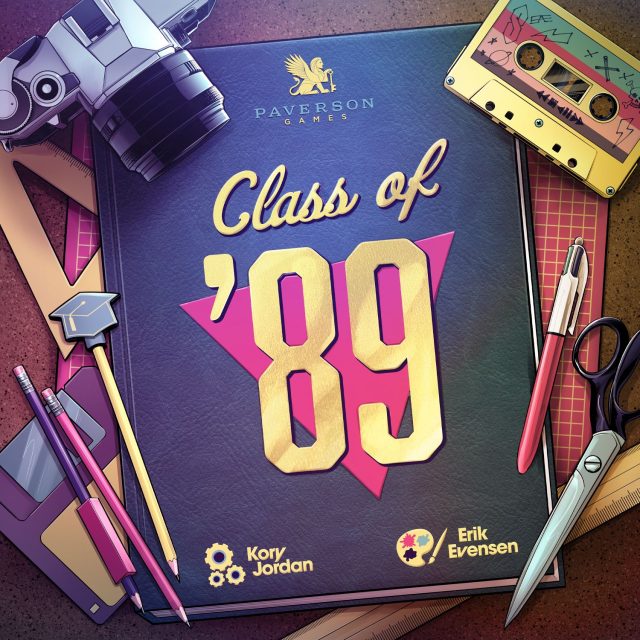
Class of '89
Class of '89 at your next game night?
Add Class of '89 to your collection, let your group vote on what to play, and keep track of winners and scores. Free, no credit card.
Add Class of '89 to my collectionAlready have an account? Log in
- Designer Kory Jordan
- Publisher Paverson Games , DSV Games
- Illustration Erik Evensen
The description, FAQ and assessments for this game were generated with the help of artificial intelligence from the game data and reviewed editorially. Spotted a mistake? Let us know.
What to Expect
You lead the Yearbook Club and send uniquely skilled staff across the school to capture moments for your spread. Gameplay mixes Tile Placement, Set Collection and Matching with proximity bonuses as you fill classes and assemble cliques. Strategic placement and the use of different worker types shape your layout and scoring as you race to create an alphabetized, high-scoring yearbook.
Who Is This Game For?
Aimed at hobby gamers and older families (14+), Class of '89 suits players who enjoy layout-driven planning and engine-style choices. A 90-minute playtime makes it a medium-length, strategy-focused experience where prior exposure to Worker Placement or Pattern Building is helpful.
How It Works
The core loop uses Worker Placement with distinct worker types to trigger actions around the school. Tile Placement and Pattern Building determine how your yearbook pages form; Matching and Set Collection score points for grouping students or elements. Tags and proximity bonuses add tactical layers, forcing trade-offs between immediate gains and long-term layout strategies.
What Makes It Special
Designed by Kory Jordan, the game ties 1980s nostalgia to a combo of Tile Placement, Worker Placement and Set Collection mechanics. Ladder Climbing/Tags and proximity scoring make the theme mechanically relevant. It appears in 'Decades: The 1980's', underlining its era-focused presentation.
Pro
- Combination of Tile Placement and Worker Placement offers tactical depth
- Strong 1980s theme supports design choices and immersion
- Different worker types increase variety and planning options
- Proximity and set-collection scoring allow multiple viable strategies
Contra
- Steeper learning curve for players new to worker placement
- At ~90 minutes, sessions are medium-length and require commitment
Setting & atmosphere
Set in a 1980s high school, the game centers on yearbook creation, cliques and extracurricular life. The theme evokes iconic teen media of that decade.
Tips for beginners
Start by focusing on clear matching and set goals and build your layout gradually rather than trying to optimize everything at once.
Frequently asked questions
Can I play this solo?
Yes. The game supports solo play as players.min = 1.
How long does a game really take?
The listed duration is about 90 minutes; teaching and setup can extend total time.
What prior experience do I need?
Familiarity with Worker Placement or Pattern Building is helpful; the game is aimed at hobby players aged 14 and up.
How does this compare to similar games?
Class of '89 pairs Worker Placement with Tile Placement and Set Collection in a tight thematic package, making layout decisions central compared to many pure worker-placement titles.
Is this suitable for families?
With a minimum age of 14 and medium-length playtime, it's better suited to older family members and hobby gamers.
What mechanic makes it special?
The interplay of Tile Placement, Different Worker Types (Worker Placement) and proximity/Tag bonuses defines its mechanical identity.
Fazit
Class of '89 is recommended for players who like thematic, layout-oriented strategy with multiple interacting mechanics. Casual players looking for very short games may find the 90-minute length and strategic depth demanding.
Class of '89 at your next game night?
Add Class of '89 to your collection, let your group vote on what to play, and keep track of winners and scores. Free, no credit card.
Add Class of '89 to my collectionAlready have an account? Log in