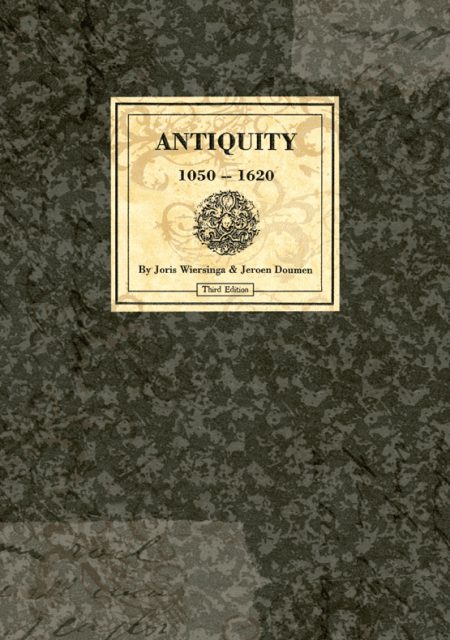
Antiquity
Antiquity at your next game night?
Add Antiquity to your collection, let your group vote on what to play, and keep track of winners and scores. Free, no credit card.
Add Antiquity to my collectionAlready have an account? Log in
- Designer Jeroen Doumen , Joris Wiersinga
- Publisher Splotter Spellen
- Illustration Ynze Moedt
The description, FAQ and assessments for this game were generated with the help of artificial intelligence from the game data and reviewed editorially. Spotted a mistake? Let us know.
What to Expect
In Antiquity, set in late medieval Italy, you develop cities and choose unique victory conditions such as population growth, trade, or conquest. The modular board features hex and square grids where you place tiles to expand your territory while managing resources carefully. Environmental depletion forces you to explore further lands as the game progresses, demanding adaptable strategies from players.
Who Is This Game For?
Antiquity targets experienced gamers who enjoy complex strategy games with long playtimes (around 180 minutes). It is a heavy eurogame suited for players familiar with city-building and economic mechanics rather than casual or family audiences.
How It Works
The game employs tile placement on a modular board with hexagon and square grids, alongside grid coverage mechanics. Players build cities and landscapes to gather resources and expand. Trading between players adds economic interaction, while environmental factors limit resource availability, requiring strategic planning and balance.
What Makes It Special
Designed by Joris Wiersinga and Jeroen Doumen, Antiquity was nominated for the 2005 International Gamers Awards in the General Strategy; Multi-player category. It features a unique combination of environmental impact within economic city-building and belongs to the polyomino components family. Variable victory conditions add to its replayability.
Awards
2005
Pro
- Multiple victory conditions encourage diverse strategies
- Blend of tile placement, grid coverage, and trading mechanics
- Modular board ensures varied gameplay each session
- Incorporates environmental depletion affecting resource management
Contra
- Long playtime of approximately 180 minutes requires commitment
- High complexity can be daunting for newcomers
- No solo mode, requires 2 to 4 players
Setting & atmosphere
The game is set in late medieval Italy, simulating city growth amid dwindling agricultural resources and environmental challenges.
Tips for beginners
Focus first on understanding core mechanics and develop a clear strategy before tackling more complex moves.
Frequently asked questions
Can I play this solo?
Antiquity is designed for 2 to 4 players and does not support solo play.
How long does a game really take?
A typical game lasts about 180 minutes, with setup and explanation adding to total time.
What prior experience do I need?
This is a complex strategy game ideal for players experienced with city-building and economic eurogames.
How does this compare to similar games?
Antiquity stands out by combining environmental impact with modular board and variable victory conditions.
Is this suitable for families?
Due to its long duration and complexity, Antiquity is better suited for experienced players rather than families.
What mechanic makes it special?
The combination of tile placement, grid coverage, and trading within an environmental context defines Antiquity.
Fazit
Antiquity is a demanding strategy game for players who appreciate deep planning and long sessions. It is less suited for casual gamers or families due to its complexity and length.
Antiquity at your next game night?
Add Antiquity to your collection, let your group vote on what to play, and keep track of winners and scores. Free, no credit card.
Add Antiquity to my collectionAlready have an account? Log in